What does Rhode Island law call a failed cesspool?
The Cesspool Act lists five conditions, and any one of them means failure: sewage at the ground surface, liquid within 6 inches of the inlet pipe's invert, pumping more than twice a year, contamination of a well or watercourse, and a cesspool bottom sitting in groundwater. Each is described in plain terms below.
The criteria come from the definitions section of the Cesspool Act. They apply to cesspools, but the same symptoms point to trouble in a septic tank and leach field too. If you are unsure which you have, start with our guide on how to tell if you have a cesspool.
| Sign | What you might notice |
|---|---|
| Sewage at the surface | Wet, smelly or spongy ground over the system |
| Liquid within 6 inches of the inlet invert | Slow drains, gurgling, backups into the house |
| Pumping more than twice a year | The pumper keeps finding it full |
| Well or watercourse contamination | A failed well test, or discharge reaching a stream |
| Bottom in groundwater | Liquid level rises and falls with the water table |
Sewage or wet ground at the surface
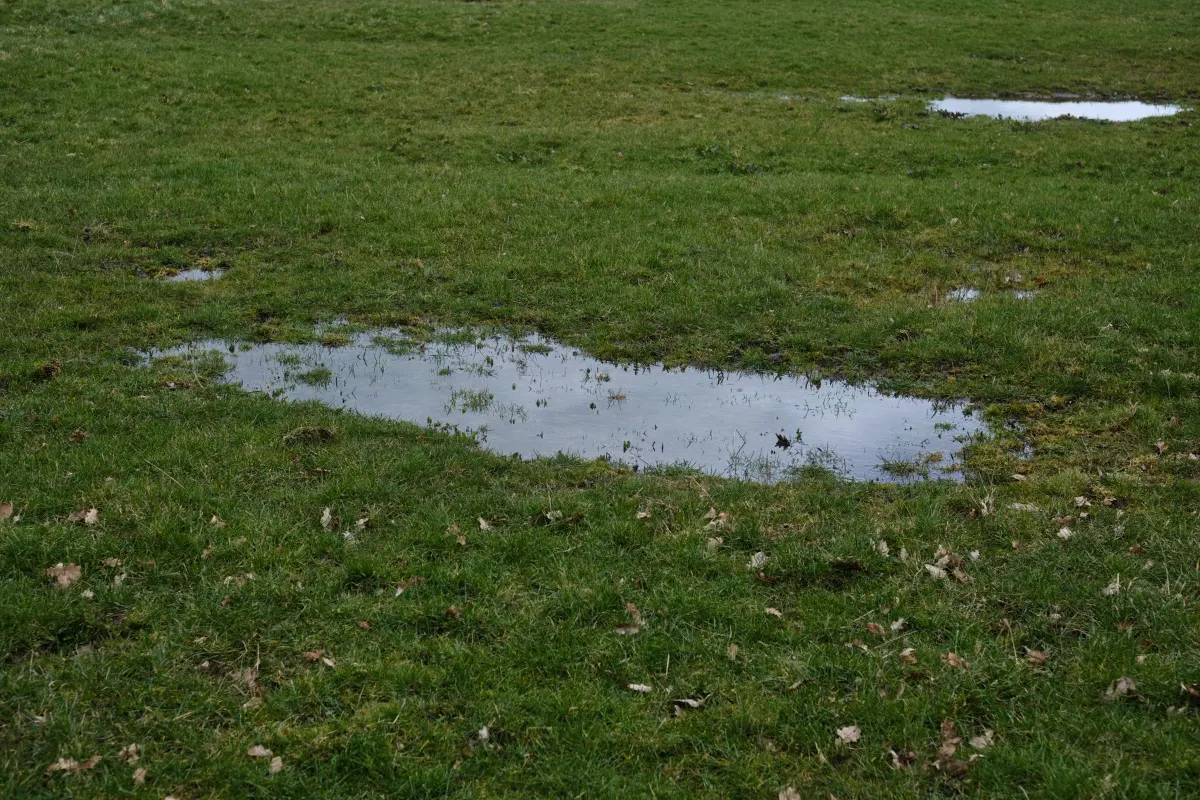
Sewage breaking out at the surface is the most visible failure. It shows up as soggy patches, standing gray water, lush green strips or a sewage smell over the cesspool or drain field, often after heavy use or rain. It means the ground can no longer absorb what the system sends it.
Keep people and pets off the area and call for help. In a drain field the fix may be a leach field replacement; in a cesspool it means replacement under the Cesspool Act.
Backups and liquid near the inlet pipe
The inlet invert is the bottom of the pipe carrying wastewater from the house into the tank or cesspool. If liquid sits within 6 inches of it, the structure is not draining, and wastewater has little room before it backs up. Slow drains, gurgling pipes and toilets that burp are the household symptoms.
An inspector or pumper can measure the level when the cover is open. A reading that high right after pumping, or one that refills quickly, points to a clogged outlet, a saturated field or a cesspool that has sealed itself with solids.
Pumping more than twice a year
A healthy system does not need pumping every few months. Rhode Island treats a cesspool pumped more than twice a year as failed, because frequent pumping only hides the problem that liquid is not soaking away. South Kingstown uses a similar test: two or more pumpings in 12 months.
Under South Kingstown's cesspool rules, a failed cesspool, or one needing that much pumping, must be replaced within 18 months of a Notice of Violation. Regular septic pumping on a normal schedule is healthy; our South Kingstown page covers that town's inspection program.
Well contamination and groundwater contact
Many South County homes have a private well on the same lot as the septic system, so a failing system can reach drinking water. A well contaminated by the system, or a cesspool whose bottom sits in groundwater, is a legal failure even if nothing shows at the surface. A water test is often the first warning.
Charlestown tracks nitrate using results from more than 360 private wells (town program), and Exeter advises private well owners to test their water (Exeter well safety). If a test comes back high, have the septic system checked as well as the well.
What happens after a failure, and what does a fix cost?
State law gives one year from discovery to properly abandon a failed cesspool, less if it is a public health hazard. Towns can move faster: Charlestown gives 60 days after a failed inspection to apply to RIDEM for a repair permit. Every repair needs a RIDEM permit, and near salt ponds it must reduce nitrogen.
The one-year rule is in § 23-19.15-6, and Charlestown's is in Chapter 210. EPA puts the national cost to fix a malfunctioning conventional system at $5,000 to $15,000 (EPA). For a full replacement, RIDEM's published ranges are about $10,000 to $15,000 conventional and $23,000 to $32,000 for nitrogen-reducing systems (RIDEM); treat these as a starting point. Narragansett's septic loan covers failed systems up to $20,000 (town page). Confirm current loan terms with your town or RIHousing. Our septic repair page covers the process, or call for a free estimate.
This is general information, not legal or tax advice.
Septic failure questions
Does a bad smell alone mean my septic system has failed?
Not by itself. A brief odor near a vent or cover can be normal. It becomes a concern when it comes with wet ground, backups or slow drains, which match the failure signs in state law. Have the system opened and the liquid level checked to know for sure.
Can pumping fix a failed cesspool?
Pumping gives short relief, but it does not fix a cesspool that has stopped draining. Rhode Island actually treats pumping more than twice a year as a sign of failure. The long-term fix is replacement with a permitted septic system or a sewer connection where one is available.
How long do I have to replace a failed cesspool?
State law allows one year from discovery, or less if the failure is a public health hazard. Some towns set their own timelines after a Notice of Violation, such as South Kingstown's 18 months. Check your town's rules and RIDEM's before you schedule work.
Do I need a permit to repair a failing septic system?
Yes. RIDEM reviews repair applications, and it lists typical review times of 1 to 2 weeks. State rules require a licensed designer to prepare the plans. Our RI septic permit process guide walks through each stage, from site suitability to the final Certificate of Conformance.
Is a failed system in a salt pond area treated differently?
Yes. In the Salt Pond and Narrow River critical resource areas, repairs generally must use nitrogen-reducing technology, with limited exceptions for repairs that only replace the septic tank. That can raise the cost, so ask your designer early whether your lot is inside one of these areas.